
Your First Martial Arts Class Is About More Than Techniques
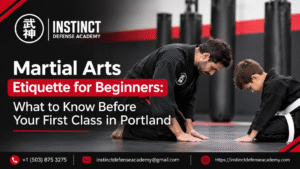
Starting martial arts can feel unfamiliar, particularly if you have never attended a structured training class before.
You may be wondering what to wear, how to address the instructor, whether you need to know any techniques, how partner exercises work, or what behavior is expected.
These questions are normal.
Martial arts schools often have class routines and etiquette that help students train respectfully and safely. Some practices are specific to a particular discipline or school, while others are common expectations across many training environments.
Understanding basic martial arts etiquette before your first class can help you feel more prepared and make it easier to focus on learning.
If you are exploring martial arts training in Portland, Bethany, or NW Portland, this guide explains the habits and questions that can help beginners get started.
What Is Martial Arts Etiquette?
Martial arts etiquette refers to the expected behavior and training customs followed by students and instructors.
It may include greeting the instructor, following class instructions, treating training partners respectfully, maintaining personal hygiene, and taking care of the training space.
Etiquette is not simply about formal traditions. It can also support a more organized learning environment.
For example, listening when instructions are given helps students understand exercises. Respecting training partners helps maintain appropriate boundaries. Arriving prepared reduces unnecessary interruptions.
The exact customs differ between schools and martial arts systems. Always follow the specific guidance provided by your instructor.
1. Arrive on Time and Be Prepared
Punctuality is one of the simplest ways to show respect for a class.
Arriving on time gives you an opportunity to prepare, understand the class routine, and avoid interrupting the instructor.
If you are running late, ask the school how it wants students to enter an ongoing class.
Before attending, confirm:
- The class start time.
- Required clothing or uniform.
- Whether footwear is worn or removed in the training area.
- Whether you should bring water.
- Any equipment required for the session.
- Whether beginners should arrive early for an introduction.
If you are attending a trial class, follow the academy’s instructions rather than assuming its routine is identical to another school.
2. Listen When the Instructor Is Speaking
Martial arts instruction often involves demonstrations and explanations.
Pay attention when the instructor is speaking, especially before a new activity begins.
If you do not understand something, wait for an appropriate moment to ask a question.
Avoid talking over instructions or beginning an exercise before the class has been told to start.
Listening carefully can help you understand the purpose of an activity and reduce confusion during practice.
3. Respect Your Training Partners
Partner practice requires cooperation.
Your training partner is there to learn, just as you are. The purpose is not to prove that you are stronger, faster, or more experienced.
Good training habits include:
- Following the exercise instructions.
- Communicating if something feels uncomfortable.
- Practicing at the agreed intensity.
- Avoiding unnecessary force.
- Giving your partner enough space.
- Stopping when the instructor tells you to stop.
If you are unsure about the appropriate level of contact, ask the instructor before beginning.
4. Understand Personal Space and Physical Boundaries
Martial arts may involve activities where students work close to one another.
That does not mean personal boundaries should be ignored.
Students should understand what an exercise involves before participating. If you have a concern about physical contact, discomfort, or a movement, communicate it to the instructor.
A responsible learning environment should allow students to raise reasonable concerns.
Never assume that a beginner must tolerate an activity that feels unsafe or that they do not understand.
5. Maintain Personal Hygiene
Personal hygiene is important in any shared physical training environment.
Before class:
- Wear clean training clothes or the required uniform.
- Keep fingernails trimmed.
- Maintain basic personal cleanliness.
- Remove jewelry when instructed.
- Cover or discuss any cuts or skin concerns according to the school’s policy.
- Bring a towel or other personal items if required.
If the school has specific hygiene requirements, follow them.
These habits help make shared training more comfortable for everyone.
6. Take Care of the Training Space
Training areas are shared spaces.
Follow the school’s instructions about where to place shoes, bags, water bottles, and personal belongings.
Do not leave equipment scattered around the training area.
If you notice a hazard or damaged equipment, tell the instructor rather than trying to fix something you are not qualified to handle.
Respecting the space is part of respecting the people who use it.
7. Do Not Pretend to Understand a Technique
Beginners sometimes feel embarrassed about asking questions.
However, pretending to understand an unfamiliar movement can create confusion and may increase the risk of mistakes.
It is better to say:
“Could you show me that movement again?”
or:
“I’m not sure I understood the position. Could you explain it?”
Learning involves questions and corrections. You are not expected to know everything during your first class.
8. Avoid Showing Off or Competing Unnecessarily
Martial arts classes may include students with different levels of experience.
Comparing yourself with advanced students can make learning more stressful than it needs to be.
Focus on understanding the instruction and practicing safely.
Avoid adding extra force, speed, or movements that have not been taught.
Progress should come from consistent practice, not from trying to impress other students.
9. Follow the School’s Specific Customs
Different martial arts systems may have different traditions.
Some schools use formal greetings or specific ways of beginning and ending class. Others have different terminology, uniform expectations, or training procedures.
If you are exploring Bujinkan Budo Taijutsu, ask the instructor to explain the school’s etiquette and the meaning of any formal practices.
Do not assume that every dojo follows identical customs.
10. Communicate About Injuries and Physical Limitations
If you have an injury, physical limitation, or health concern that may affect participation, discuss it with the school before training.
Do not hide discomfort simply because you do not want to interrupt the class.
If an activity causes pain or feels unsafe, stop and communicate with the instructor.
The instructor can explain whether the activity should be modified, paused, or avoided. For medical concerns, consult an appropriate healthcare professional.
What Should Beginners Avoid During Martial Arts Training?
A few common mistakes can make the first experience more difficult.
Arriving without checking requirements: Different schools have different clothing, equipment, and arrival instructions.
Ignoring instructions: Beginning a movement before understanding the demonstration can create confusion.
Using unnecessary force: Partner practice should follow the instructor’s guidance.
Comparing progress: Every student learns at a different pace.
Being afraid to ask questions: Clarification is part of learning.
Ignoring personal boundaries: Students should communicate discomfort and follow safety instructions.
Assuming all martial arts schools are the same: Training customs vary by discipline and instructor.
Does Martial Arts Etiquette Differ in Traditional Japanese Martial Arts?
Yes. Some traditional Japanese martial arts schools use specific etiquette, terminology, and formal practices connected to their training culture.
The details vary by system and individual school.
Students should ask their instructor about:
- How classes begin and end.
- How students address the instructor.
- Whether formal greetings are used.
- How training equipment is handled.
- How students line up or organize themselves.
- What behavior is expected during demonstrations.
- How partner practice is started and stopped.
If you are interested in Bujinkan Budo Taijutsu, learning the school’s specific expectations can help you participate more comfortably.
The purpose of etiquette should be explained clearly, especially to beginners who are encountering these practices for the first time.
How to Prepare for Your First Martial Arts Class in Portland
Before attending a class, contact the school and confirm the practical details.
Ask what clothing to wear, when to arrive, whether equipment is required, and whether beginners can observe or participate in a trial session.
If you are travelling from Bethany or NW Portland, plan your journey so you can arrive without rushing.
You can explore Instinct Defense Academy’s Adult Classes to learn about its adult training offering.
Those interested in women’s training can review Empower Her.
For trial-class information, visit Instinct Defense Academy Trial Classes.
Contact the academy to confirm current class availability, program details, and the etiquette expected during your first session.
Frequently Asked Questions
1. What should I know before my first martial arts class?
Confirm the class time, clothing requirements, arrival instructions, and whether you need equipment. Be prepared to listen, ask questions, and follow the instructor’s safety guidance.
2. Do beginners need to know martial arts etiquette?
No previous experience is required. The instructor or school should explain the customs and class expectations to new students.
3. Why is respect important in martial arts?
Respect supports clear communication, responsible partner practice, and a more organized learning environment. It applies to instructors and fellow students.
4. What should I call my martial arts instructor?
This depends on the school’s customs. Ask the instructor how they prefer to be addressed rather than assuming every school uses the same title.
5. Can I ask questions during martial arts class?
Yes. Ask at an appropriate time, especially if you do not understand a movement or safety instruction.
6. Is physical contact normal in martial arts training?
Some programs include partner activities and controlled physical contact, while others may use different methods. Ask what a class involves before participating.
7. What should I do if a training exercise feels uncomfortable?
Stop if necessary and communicate your concern to the instructor. You should understand an activity and its expectations before continuing.
8. Do all martial arts schools follow the same etiquette?
No. Customs vary by discipline, instructor, and school. Follow the specific instructions provided by your training academy.
9. Is Bujinkan Budo Taijutsu training formal?
Traditional schools may have specific etiquette and class practices. Ask the instructor about the customs followed at the school you are considering.
10. Can I attend a trial martial arts class in Portland?
You can contact Instinct Defense Academy and ask about its current trial-class options, requirements, and schedule.
Start Training With Respect, Curiosity, and Consistency
Your first martial arts class does not require perfection.
Arrive prepared, listen carefully, respect your training partners, and ask questions when you need clarification. These simple habits can help you become more comfortable with the training environment.
Whether you are exploring martial arts for personal development, structured physical activity, or traditional practice, understanding class etiquette is a useful first step.
Contact Instinct Defense Academy
Website: https://instinctdefenseacademy.com/
Email: instinctdefenseacademy@gmail.com
Phone: +1 (503) 875-3275
Explore a Trial Class
View Trial Classes at Instinct Defense Academy